
Apostille (legalisation)
of documents issued in the Slovak Republic
Legalisation of the issuing body.
An Apostille is attached to the original document, so you might also need an official translation. The price for such translation is usually 30 EUR per standard page.
Countries: EU and most of the developed countries complete list.
Price: from 120 EUR
Period of delivery: 1-5 days
11
Years of experience
180
Google references
0
Complaints
What type of documents are apostilled?
Vital records
- birth certificate
- marriage certificate
- death certificate
- certificate of no impediment
- confirmation of marriage
- divorce decree
- certificate of divorce
Personal documents
- passport
- identity card
- driving licence
- certificate of Slovak citizenship
Education or qualification certificates
- school reports
- diplomas
- diploma supplements
- certificates of education
Business Register and Trade Licence Register
- trade licence
- extract from the Business Register
- certificate of data registration in the Business Register
- certificate of tax residency
Business, enterprises and companies
- articles of association
- affidavits
- powers of attorney
- contracts with business partners
- memorandum of association
- certificate of trademark registration
Criminal Records
What is an Apostille?
An Apostille (or apostillisation) is a form of higher document authentication that verifies the authenticity of the signature, the capacity of the person who signed the document, and the identity of the seal or stamp it bears.
You will need an Apostille if you are submitting an official Slovak document abroad (or a foreign document in Slovakia) and the destination country is a contracting party to the Hague Apostille Convention.
When is a document Apostille required?
Powers of Attorney for use abroad: For various purposes, including representation before foreign authorities, buying or selling real estate, property management, banking transactions, or director authorization for foreign companies.
Work and business abroad: Incorporating and registering companies, deeds of incorporation, articles of association, Criminal Record Extracts required by foreign employers, and verification of university diplomas, high school certificates, or professional qualifications.
Studying abroad: Applications for colleges and universities, certificates of enrollment, and academic transcripts.
Personal and family matters: Marriage abroad, applying for permanent or temporary residence, inheritance proceedings, and registry documents (birth certificate, marriage certificate, death certificate).
How to combine an Apostille with a certified translation?
If you need to submit a document abroad, an Apostille alone is usually not enough. Foreign authorities also require an official (sworn) translation.
Correct procedure:
Obtaining the original or a notarized copy: First, the document must be in the required format (some authorities require a fresh registry extract no older than 3–6 months; the same applies to criminal record extracts and business documents). We check the client’s documents free of charge and suggest the proper procedure, tailored to individual needs for maximum efficiency. We can also request most documents or their duplicates directly on your behalf via a Power of Attorney.
Obtaining the Apostille: The Apostille is always attached to the original document first. For certain document types (such as educational certificates), a notarized copy may then be created to bind it with the translation. We clarify this step on a case-by-case basis based on our experience.
Official (sworn) translation: The document, along with the attached Apostille, is officially translated (including the full text of the Apostille clause itself). Our translations are provided exclusively by sworn translators registered with the Ministry of Justice of the Slovak Republic.
Translation verification (if required): Certain countries also require an Apostille on the sworn translator’s clause itself (an Apostille on the translation).
At the Legalization Center, we provide a complete all-in-one service: from obtaining the Apostille to providing official translations into more than 30 languages.
Apostille attestation process
Non-binding inquiry
Delivery of documents
Document attestation
Delivery of a legalised document
Why us
- Thousands of verified documents, great ratings from clients and 0 complaints.
- We will take care of everything for you, so you do not waste your time and nerves running around the offices.
- Most offices have a 30-day deadline to verify the documents, we will manage 90% of the verification within 1-5 days.
- The originals are safe – we store them in a secure location and send them reliably by courier
JUDr. Veronika Michalikova, MBA
Matej Michalik
FAQ
What does an Apostille look like?
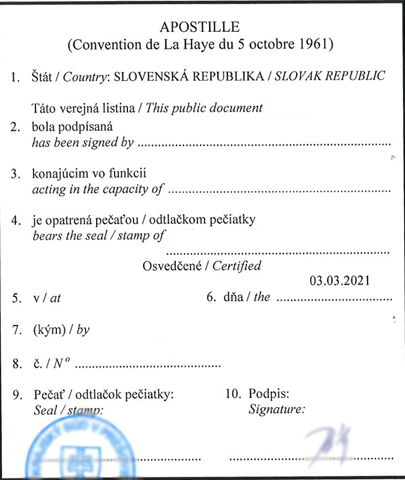
An Apostille (or Apostille certificate) is a square stamp printed directly onto the original document or applied as a traditional stamp impression. If there is insufficient space on the original document for the Apostille certificate, it is attached on a separate sheet securely bound to the original.
It contains several standardized details (e.g., the name of the issuing country, the name and capacity of the signatory, the official seal/stamp, the date, the Apostille registration number, and the signature of the issuing official).
What language is the Apostille issued in?
The header of the Apostille is always written in French: “Apostille (Convention de La Haye du 5 octobre 1961)”. In Slovakia, the details within the Apostille are filled out in Slovak (or combined with English by certain authorities). For this reason, once the document is apostilled, an official translation is prepared to translate the text of the Apostille into the target country’s language as well.
How much does an Apostille cost and what is the processing time?
The price varies depending on the type of document. Please click through to the specific document types at the top of this subpage, where prices covering the entire process, including administrative fees are listed. Processing times are also specified for each document type.
Standard statutory processing times for authorities are 30 days; however, we handle most authentications within 1–5 days, depending on the document type and place of issue. We design the fastest possible procedure tailored to each client’s specific situation.
Processing speed depends on several factors: the document type, place of issue, destination country, whether an official translation is required, whether we will be requesting the document on your behalf via Power of Attorney, etc.
Do I need to submit the original document?
Yes, in most cases, both the Apostille certificate and superlegalization are applied directly to the original document.
How can I deliver the documents to you?
You can deliver your documents to us by mail or in person every business day from 8:00 AM to 5:00 PM.
How much does an official translation cost?
An official translation usually costs €35 per standard page including VAT (we are VAT registered).
How long is an Apostille / superlegalization valid?
An Apostille certificate or superlegalization does not expire. However, you should check with the target country regarding how recent the underlying document itself must be. In most cases, authorities accept documents issued within the last 6 months sometimes within a maximum of 90 days.
Can you also arrange an Apostille for documents issued abroad?
Yes, send us a scan of the document by email and we will send you a price quote.
Will you need a Power of Attorney?
In most cases, we do not need a Power of Attorney. If we do, we will inform you in advance. We will draft the Power of Attorney for you.
How will you deliver the completed document to me? Do you ship internationally?
You can pick up your apostilled / superlegalized document in person at our law office, or we can send it to you by post free of charge. Courier delivery within Slovakia costs €30; international delivery will be quoted individually.
Who issues Apostilles in Slovakia?
Authority jurisdiction depends on the type and origin of the specific document. Unlike in some countries, Slovakia does not have a single centralized authority issuing Apostilles. Instead, authority is divided among several institutions (e.g., the Ministry of Foreign and European Affairs of the Slovak Republic, Ministry of Education, Ministry of Health, General Prosecutor’s Office, regional courts, or district offices for registry documents).
Leave the entire process to us—instead of determining the correct authority, buying fee stamps, and waiting at offices, we handle the complete apostillisation and official translations for you. While most authorities have a statutory deadline of 30 days, we manage most tasks within a few days, and sometimes even while you wait.
When can a document NOT be apostilled, and what should be done?
A document cannot be apostilled in the following cases:
The destination country is not a party to the Hague Convention: In this case, superlegalization (consular authentication via the Ministry of Foreign and European Affairs of the Slovak Republic and the relevant embassy) is required.
The document is damaged, illegible, or outdated: The date of issue is strictly monitored, especially for registry documents (birth, marriage, or death certificates), criminal record extracts, or commercial documents such as corporate registry extracts.
It is an unverified private document: An Apostille can only be affixed to a public document or a private document bearing an officially notarized signature.
Commercial, customs, or diplomatic documents: These are subject to a special verification regime.
If you are unsure whether your document can be apostilled, contact us, we will review your document free of charge.